Wednesday, December 15, 2021

Children Christmas party and camp-2021 Updates ie. "We need your kindness please"

Children Christmas party and camp-2021 Updates ie. "We need your kindness please" - 

Children Christmas party and camp-2021 Updates ie. "We need your kindness please"


CThanksgiving Committee <cthanksgiving@quakersaustralia.info>

10:17 AM (3 hours ago)


to tevans, DLHarradine, me

===

Topsy, Lee

We have a further request from the Friends Orphanage School in Uganda.

Sejin Pak contacted me this morning to ask about the work of the TGF Committee - as he has been approached by nominations. I have invited him to attend this afternoon's session so he can gain a sense of what we do.


I will see you all at 17:00.


Next Committee Meeting:

Thursday Dec 16, 2021 at 17:00

https://us02web.zoom.us/j/85875452036?pwd=M3BhUTRmQVlFcGZya3pIZSt0TkZqUT09

Meeting ID: 858 7545 2036

Passcode: 389552


David


---------- Forwarded message ---------
From: Apostle Ruhasha Dickson <friendsoforphans@gmail.com>
Date: Wed, Dec 15, 2021 at 10:45 PM
Subject: Children Christmas party and camp-2021 Updates ie. "We need your kindness please"
To: <cathy@lccredding.org>


Praise the Lord and hope all is doing well with you? I kindly request you to join hands with us to end malnutrition among children here caused by monotony of food supplies in this Thanksgiving and festive season as we approach the remembrance of the birth of our savior Jesus Christ.

I can’t think of a worse combination: Thanksgiving, Christmas and hunger. No child should wake up on these thanksgiving days or Christmas morning with hunger pangs With no food on the table to make children's lives better. But that’s exactly what is going on and how it is to be for too many children Unless you and I stand up and help them. Can you be kind enough to donate $50, $100, $200, $500 or more as Christmas Gift to end kids hunger pains or provide each child with a pair of clothes? receipts, photographs, video documentaries and progressive reports will be presented to you.

Children Christmas party and Camping-2021 i.e. 19th - 25th December 2021. Give Chance to children that lost their parents/families and God will bless you abundantly Proverbs 19:17 Says “He that hath pity upon the poor lendeth unto the LORD; and that which he hath given will he pay him again.”


In Christian Love,

Pastor Dickson and Allen Ruhasha
CEO Friends Orphanage Project Inc.
P.o Box 34191
Kampala - UGANDA

East Africa
+256 772 692 476
www.friendsorphanageschool.org


Sunday, December 12, 2021

10 years of Kim Jong Un: What was Washington’s best North Korea decision so far? | NK News

10 years of Kim Jong Un: What was Washington’s best North Korea decision so far? | NK News


10 years of Kim Jong Un: What was Washington’s best North Korea decision so far?
Experts vote on what they think were the best calls the US made on North Korea since 2011
Chad O'Carroll December 10, 2021

SHARE
Image: Pixabay, edited by NK News | Full Moon on Capitol Hill Washington


Washington has for decades tried to convince North Korea not to pursue nuclear weapons, and then once it had them, to give them up.

This hasn’t worked, for the very simple reason that there is no better security guarantee for a paranoid Pyongyang leadership that understands much of the world would rather it be gone. However, there have been times when it looked like U.S. policies were making inroads — sometimes to the surprise of long-time North Korea watchers.


Furthermore, some U.S. policies result in peninsular constants that have effectively prevented tensions bubbling over into actual conflict, something which ought not to be taken for granted.

Looking back at Kim Jong Un’s first 10 years in power, what was Washington’s best North Korea-focused decision?

In the third of a six-part series to mark the initial decade of North Korea under Kim Jong Un, NK News answers this question with results from a major survey of international North Korea watchers.

The survey, which questioned 250 North Korea watchers about Kim’s rule and Washington’s policy responses to date, included finalized data and explanations from 82 different respondents (47 on-record and 35 anonymously).

In reverse order, here’s what expert participants thought were Washington’s best four North Korea-related decisions since 2011:Hotel staff waiting by a wall of clocks in North Korea, May 2019 | Image: NK News

#4 (4.9% of votes) – “Strategic patience” under President Barack Obama

Though less than five percent of respondents’ top choice, the Obama-era policy of “strategic patience” was, for some, the best call of the past 10 years.

“‘Strategic patience’ is often judged too harshly,” said Thomas Schafer, Germany’s former ambassador to North Korea. “(But) it included all essential elements: ramping up sanctions, keeping the alliance with South Korea a top priority, plus remaining open to contacts and negotiations — even after the attempt to negotiate the Leap Day Agreement of 2012 failed.”

In a nutshell, “strategic patience” set out to pressure North Korea through sanctions, diplomatic isolation and military deterrence over the long term, in the hope that Pyongyang would eventually capitulate and enter into serious denuclearization talks.

Looking back, Schafer said that “the Obama administration should not be blamed for the lack of negotiations after 2012 as it was Pyongyang’s choice not to negotiate: It takes two to tango.”

Another observer said it was the best of a lousy selection of policy options.

“Strategic patience was maybe the best in order to keep North Korea away on the geopolitical map,” said Thomas Fisler, a former Swiss aid worker stationed in Pyongyang for several years.The United Nations Security Council Considers DPRK issues in 2018 | Image: U.N.

#3 (8.5% of votes) – Significantly ramping up unilateral and U.N. sanctions on North Korea

Donald Trump made clear he was prioritizing the threat posed by North Korea after becoming U.S. president in 2017. The result? As a two-month policy review wrapped up alongside the rising tempo of North Korean missile testing in early 2017, Washington revealed its new strategy: “Maximum pressure and engagement.”

Part of that effort was to significantly squeeze North Korea’s economy through sanctions, both from the U.N. Security Council (UNSC) and the federal government, in order to stimulate good-faith negotiations on denuclearization.

The year 2017 consequently saw a sharp rise in the application of sanctions on North Korea — spurred on by the DPRK’s nuclear and weapons testing — with four rounds of U.N. Security Council resolutions applied that year alone — all of which still remain on the books.

For some experts, Washington’s economic pressure on Pyongyang remains the smartest decision by the White House during the first 10 years of Kim’s rule.

“The strong resolutions significantly reduced North Korea’s foreign income,” said Maiko Takeuchi, a former member of the U.N.’s 1874 Panel of Experts. “(And) as the measures expanded, awareness on the issue in Africa and the Middle East increased significantly.”

Though Takeuchi said North Korea has since found ways around some of the sanctions, “the consecutive resolutions since 2270 (2016) were good decisions.”

Bruce Bennett, of the RAND Corporation, said in North Korean culture “power matters.”

“The sanctions demonstrate to the regime that it will pay a penalty for violating U.N. Security Council Resolutions.” However, Bennett conceded that “none of the actions taken thus far are near enough to motivate North Korean denuclearization.”

Bong Young-shik, a professor at the Yonsei Institute for North Korean Studies, said that recent sanctions had “hit North Korea where it hurts” and make Pyongyang feel the “burden” of “having nuclear weapons.”UNC/CFC/USFK Commander Paul J. LaCamera (second to the right) in 2021 | Image: UNC/CFC/USFK Flickr

#2 (26.8% of votes) – Keeping the alliance with South Korea a top U.S. priority, both from diplomatic and military perspectives

A constant for decades since the Korean War, the U.S.-ROK alliance has remained a priority at nearly all levels of the U.S. government throughout the Kim Jong Un era.

Though former President Trump may have tweeted his personal hot takes about the defense agreement between Washington and Seoul, he nevertheless relied on the U.S. military commitment to deter the DPRK throughout his presidency.

The constant support for the alliance with South Korea — both from military and diplomatic perspectives — during Kim Jong Un’s first decade in power received the second-highest number of votes from experts polled by NK News.

“The ROK-U.S. alliance remains vitally important to peace and security on the Korean Peninsula and in the Asia Pacific region,” said Amanda Mortwedt Oh of the Committee for Human Rights in North Korea (HRNK).

“Washington has been diligent and consistent in promoting the alliance and communicating the need to continue to address North Korea from a position of strength and partnership with the ROK,” she said.

And one of the reasons promoting the alliance is important, said Balazs Szalontai of Korea University, is because “friction between the U.S. and ROK is more advantageous to Pyongyang than either Washington or Seoul.”

Christopher Green, of Leiden University in the Netherlands, said that overall, “the alliance is a force for stability,” without which the risk of conflict would be “much greater”.

“This is the most important path to maintaining peace and stability on the Korean Peninsula,” agreed Terence Roehrig of the U.S. Naval War College.


Besides keeping the peace, experts said there were other reasons for South Korea to continue justifying the alliance.

“Regardless of the outcome of the next election in South Korea, it is important that Seoul does not feel abandoned,” said Stephen Blancke, a specialist on DPRK intelligence gathering.

“(South Korea) also faces an offensive China in its confrontation with North Korea,” Blancke said, further justifying ROK needs for the alliance.

Fyodor Tertiskiy, a North Korea specialist at Kookmin University, said that because there is little that can be practically done about Pyongyang’s nuclear program, “keeping good relations with a reliable ally is, of course, a wise and pragmatic foreign policy choice.”Kim Jong Un and then-U.S. President Donald Trump shake hands at the Inter-Korean border, June 30, 2019 | Image: Trump White House

#1 (43.59% of votes) – President Trump’s summit diplomacy with Kim Jong Un

After a year of “fire and fury” and palpable concerns that open conflict would break out on the Korean Peninsula, the sudden, precedent-busting announcement that Donald Trump would accept a meeting with Kim Jong Un was one of the least expected developments of the last 10 years.

Immediately, critics warned that granting Kim a meeting with a sitting U.S. president could be seen as a reward for bad North Korean behavior and that the summit risked unnecessarily legitimizing Kim Jong Un on the international stage.

Some were more optimistic, however, saying the novelty of leader-to-leader engagement with the DPRK had a much greater chance of breaking through the status quo than anything else tried by prior U.S. administrations.

Of all the questions posed by NK News for this survey, there was overwhelming agreement that White House support for U.S.-DPRK summits in Singapore and Hanoi represents the best decision by Washington during the Kim Jong Un era.

“The meetings created a new avenue for negotiation and brought Kim out of North Korea to the world,” said Doug Bandow, a senior fellow at the CATO Institute, noting “he proved adept at international diplomacy and might eventually decide to rejoin the process.”

Dean Ouellette of Kyungnam University said that the summits provided a rare moment of clarity for the two leaders to hear each other out in a direct way. “Nothing sets the tone, creates opportunities, or engages the public’s attention quite so well as a good tete-a-tete between two leaders.”

One anonymous survey respondent said Trump’s participation in the summits “unlocked the way forward with North Korea,” even if it was subsequently clear that the U.S. president was lacking another strategy to deal with Kim beyond maximum pressure.

Positivity about the summits, but disappointment in their outcome, was a common sentiment among respondents.

“If the developments away from U.S. hostility had been maintained, there would have been benefits for the U.S., the DPRK and the rest of the region,” said Jim E. Hoare, the U.K.’s founding chief diplomat at its embassy in Pyongyang.

“Probably the DPRK missile and nuclear programmes would have been halted — as they were in the 1990s — and sensible negotiations could have got underway,” he said

Trump’s impulsiveness in agreeing to the summits probably made them possible in a way that would have always been unimaginable under other U.S. presidents, who would have been much more cautious, one other anonymous respondent pointed out.

“To that end, the answering of the ‘what if’ questions about leader-to-leader diplomacy and simply trying something new for me outweighs any perceived negatives of emboldening/recognizing/validating Kim’s position,” the survey respondent said.

And that might have future benefits for the U.S., another expert speculated.

The Trump-Kim summits “removed or at least lowered the barrier to future such meetings which, if better prepared and under better circumstances, can actually yield real results,” said Ruediger Frank of the University of Vienna.

“Mr. Trump deserves credit for that, even though to many, he was the wrong man doing the right thing at the wrong time.”

Edited by Arius Derr

Pioneers, propaganda and play: North Korean children's education — in photos | NK News

Pioneers, propaganda and play: North Korean children's education — in photos | NK News:

Pioneers, propaganda and play: North Korean children’s education — in photos

Photos from inside the DPRK show how the state molds young students into devoted revolutionaries and loyal citizens

There is a famous saying in North Korea that reflects the diligent attention the state pays to children’s upbringing and education: “Children are the kings of the country.”

The DPRK grooms students from kindergarten to be devoted revolutionaries for life. Children spend hours and hours studying the Juche ideology of self-reliance and learning the history of their country’s revolution against Japanese and Western forces.

The goal is for for students to show their love, loyalty and admiration for their leaders and to keep the Party in their hearts forever. All other subjects are secondary.

The photos in this gallery provide a sense for what education is like for North Korean children — from young pioneers wearing bright red neckerchiefs and colorful children’s textbooks, to extracurricular activities, school lunches and playgrounds that double as propaganda.

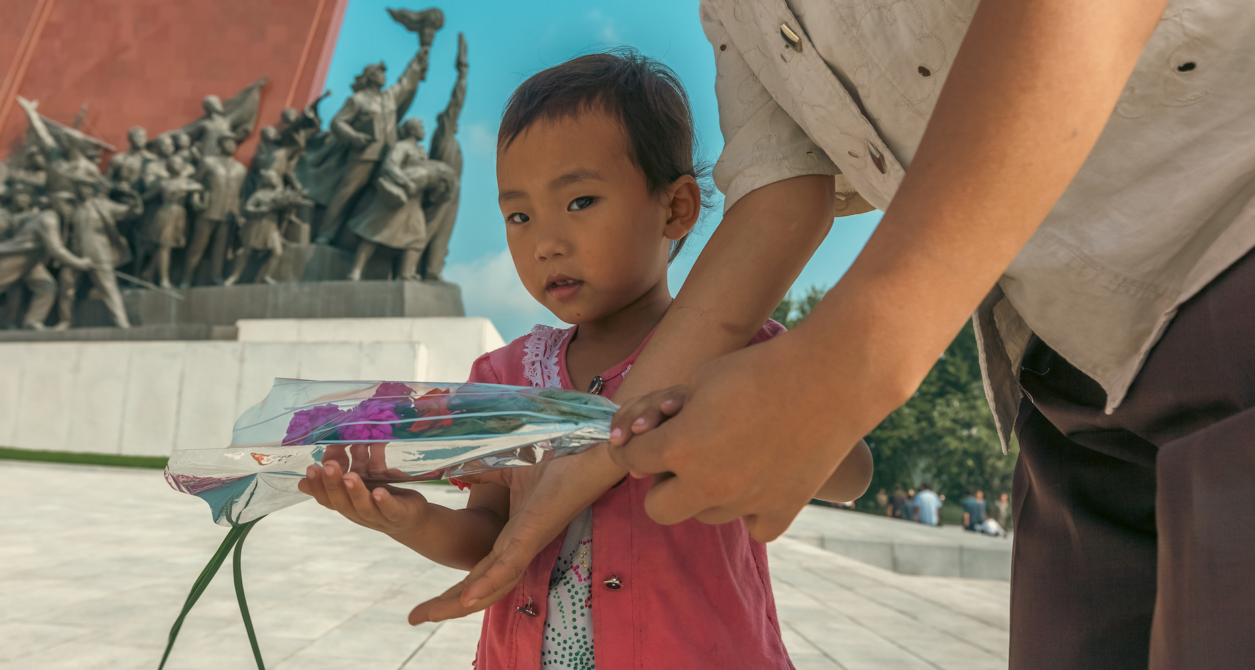
Young pioneers of the Korean Children’s Union stand ready to lay flowers at the statues of former leaders Kim Il Sung and Kim Jong Il in Pyongyang | Image: NK News (Sept. 9, 2012)


Two girls stand in front of an exhibit showing the Juche Tower on top of a globe at the Kimilsungia and Kimjongilia Exhibition Hall in Pyongyang. Former leader Kim Il Sung introduced Juche, the state ideology of self-reliance, and it has since been enshrined in North Korean law as principles that all citizens of the country must adopt and follow. | Image: NK News (Sept. 9, 2008)


Kindergartens and many elementary schools across the DPRK have wall artwork that is distinct to the country. Common subjects include praise for the military, advancements in science and technology, reunification of the two Koreas and characters from popular children’s stories. | Image: NK News (March 18, 2019)


Two girls carry backpacks while walking in Pyongyang, with one bearing a Korean phrase (탕구심) that means “inquiring mind.” Kindergarteners and elementary schoolers typically use backpacks that are brightly colored, with cute animal characters such as bears, rabbits, birds, hedgehogs, elephants and tigers. | Image: NK News (Sept. 7, 2017)


Kindergarten students exercise at a school in Kaesong. The start of the school day usually begins with physical exercise, followed by classes. It is not uncommon to see paintings or charts, plastered along corridors in schools, that detail the benefits of daily exercise, eating nutritious food and cultivating healthy habits. | Image: NK News (April 21, 2008)


Young students join in morning exercise and singing, to accordion accompaniment, at a school in Hamhung. The entrance facades of all schools feature messages thanking the country’s leaders for their benevolence, like this one that reads, “Thank you, our beloved leader Kim Jong Un.” | Image: NK News (Sept. 12, 2012)


Children dance and sing at school near Nampho. One of the first songs kids learn includes the lyrics, “We are all brothers and sisters, we have nothing to envy in this world.” | Image: NK News (Sept. 5, 2015)


A poster that says “Studying time is really good” at a school in Chongjin. Education is free for all citizens in the DPRK. It starts with one year of kindergarten, followed by four years of elementary school, six years of secondary school and then university. | Image: NK News (May 8, 2010)


A selection of educational children’s books from the DPRK. Books by celebrated authors including fable-like stories, such as about a small hedgehog who was even able to defeat a mighty tiger or rabbits that outwitted an old wolf. These days, “Snow White and the Seven Dwarfs” is also popular. | Image: Sept. 7, 2018


Domestically produced pens, notebooks, pencils, sharpeners and erasers on display at a shop in Hamhung. Large murals and billboards with the slogan “Let’s study for the sake of Korea (조선을 위하여 배우자)” are omnipresent at schools and universities across the country and also appear on the student notebooks in the photo above. | Image: NK News (Sept. 12, 2012)


Young students at an elementary school outside of Pyongyang. All classrooms display mandatory portraits of former leaders Kim Il Sung and Kim Jong Il, and sometimes quotes from the leaders as well. The boys here sit on padded cushions placed on what are likely hard wooden chairs. | Image: NK News (Sept. 10, 2015)


A little boy rests on his desk while his classmates participate in a class at the Chongjin Steel Works Factory Kindergarten in Chongjin. Many children go to schools located next to or in close proximity to the factories where their parents work during the day. | Image: NK News (June 8, 2019)


Kids use an exercise book while learning the letters of the Korean alphabet at the Chongsan-ri Cooperative Farm. Kindergarten and early elementary school textbooks tend to pop with color and be very pictorial. | Image: NK News (May 16, 2009)


A young boy wears the characteristic red neckerchief of the Korean Children’s Union. All students are initiated into the union as young pioneers at the age of six. At a special ceremony, they receive the red neckerchief and a badge that says “Always ready (항상 준비).” | Image: NK News (May 10, 2010)


A North Korean girl reads from an English lesson book in a language class at Chonsam-ri Cooperative Farm. The opportunity to study foreign languages is highly coveted in the country, as proficiency in a foreign language can improve one’s prospects to get a good job and likelihood of working overseas. | Image: NK News (April 16, 2008)


Two girls practice speaking in a foreign language at a school near the Mangyongdae District of Pyongyang. | Image: NK News (Sept. 10, 2015)


North Korean young pioneers at the Songdowon international children’s camp in Wonsan. Students who excel are rewarded with special responsibilities, and the most important is participating in self-criticism class, at which students must confess their own failures as well as those of their schoolmates. These students stand out thanks to the special badges they wear over the chest. Model students also receive badges with red stars and stripes that they pin on their shirt sleeves. | Image: NK News (Sept. 10, 2012)


A girl sweeps the area around Mansudae Hill in Pyongyang. Students are expected to help out with tasks like keeping monuments clean, painting sidewalks and watering plants. | Image: NK News (Sept. 9, 2017)


It’s not all work and no play for North Korean students. Schools stress the importance of a variety of extracurricular activities, such as those shown above at an event in Pyongyang to mark Children’s Day. North Korea observes the holiday on June 1 each year, and children get a day off from school and the opportunity to participate in fun activities. The balloon arch in the photo reads “Nothing to envy in the world.” | Image: NK News (May 31, 2019)


Young boys play soccer at a school in Pyongsong. During breaks from their classes, many students opt to play basketball, volleyball, soccer and other sports. | Image: NK News (Sept. 10, 2015)


Young girls enjoy a picnic at a park in Pyongyang. Their lunch boxes include fried fish and rice. Schools teach the importance of taking care of one’s health and eating nutritious food. | Image: NK News (April 25, 2010)


A boy walks by a slide at a school playground in Hamhung. It is common to see playground equipment fashioned in the image of military objects, such as rockets, tanks and battleships. The text on the rocket reads “Juche Korea,” while that on the slide says “strong and prosperous nation.” | Image: NK News (Sept. 11, 2012)


Like children everywhere else in the world, some can be cheeky. A young boy returning from school takes aim at a passing vehicle at a village in North Hamgyong Province. | Image: NK News (June 9, 2019)


Boys play with mini toy cars at Kim Il Sung Square in Pyongyang. For all young people in the DPRK, whether a model student or a troublemaker, what matters for advancement in life is that they demonstrate their fierce loyalty to the country’s leaders, party and revolution. They are taught to believe that their great leaders watch over them from birth to death. As a line from a famous North Korean song goes, “Our country cannot exist without you.” | Image: NK News (Sept. 9, 2012)

Edited by Bryan Betts

Monday, December 6, 2021

Privacy Policy | NK News - North Korea News

Privacy Policy | NK News - North Korea News

PRIVACY POLICY

Effective date: September 30, 2018

NK Consulting INC (Korea Risk Group) (“us”, “we”, or “our”) operates the https://www.nknews.org/ website (hereinafter referred to as the “Service”).

This page informs you of our policies regarding the collection, use and disclosure of personal data when you use our Service and the choices you have associated with that data.

We use your data to provide and improve the Service. By using the Service, you agree to the collection and use of information in accordance with this policy. Unless otherwise defined in this Privacy Policy, the terms used in this Privacy Policy have the same meanings as in our Terms and Conditions, accessible from https://www.nknews.org/

Definitions

  • Service
    Service is the https://www.nknews.org/ website operated by NK Consulting INC (Korea Risk Group)
  • Personal Data
    Personal Data means data about a living individual who can be identified from those data (or from those and other information either in our possession or likely to come into our possession).
  • Usage Data
    Usage Data is data collected automatically either generated by the use of the Service or from the Service infrastructure itself (for example, the duration of a page visit).
  • Cookies
    Cookies are small files stored on your device (computer or mobile device).
  • Data Controller
    Data Controller means the natural or legal person who (either alone or jointly or in common with other persons) determines the purposes for which and the manner in which any personal information are, or are to be, processed.

    For the purpose of this Privacy Policy, we are a Data Controller of your Personal Data.

  • Data Processors (or Service Providers)
    Data Processor (or Service Provider) means any natural or legal person who processes the data on behalf of the Data Controller.

    We may use the services of various Service Providers in order to process your data more effectively.

  • Data Subject (or User)
    Data Subject is any living individual who is using our Service and is the subject of Personal Data.

Information Collection and Use

We collect several different types of information for various purposes to provide and improve our Service to you.

Types of Data Collected

Personal Data

While using our Service, we may ask you to provide us with certain personally identifiable information that can be used to contact or identify you (“Personal Data”). Personally identifiable information may include, but is not limited to:

  • Email address
  • First name and last name
  • Phone number
  • Address, State, Province, ZIP/Postal code, City
  • Cookies and Usage Data

We may use your Personal Data to contact you with newsletters, marketing or promotional materials and other information that may be of interest to you. You may opt out of receiving any, or all, of these communications from us by following the unsubscribe link or the instructions provided in any email we send.

Usage Data

We may also collect information on how the Service is accessed and used (“Usage Data”). This Usage Data may include information such as your computer’s Internet Protocol address (e.g. IP address), browser type, browser version, the pages of our Service that you visit, the time and date of your visit, the time spent on those pages, unique device identifiers and other diagnostic data.

Tracking & Cookies Data

We use cookies and similar tracking technologies to track the activity on our Service and we hold certain information.

Cookies are files with a small amount of data which may include an anonymous unique identifier. Cookies are sent to your browser from a website and stored on your device. Other tracking technologies are also used such as beacons, tags and scripts to collect and track information and to improve and analyse our Service.

You can instruct your browser to refuse all cookies or to indicate when a cookie is being sent. However, if you do not accept cookies, you may not be able to use some portions of our Service.

Examples of Cookies we use:

  • Session Cookies. We use Session Cookies to operate our Service.
  • Preference Cookies. We use Preference Cookies to remember your preferences and various settings.
  • Security Cookies. We use Security Cookies for security purposes.

Use of Data

NK Consulting INC (Korea Risk Group) uses the collected data for various purposes:

  • To provide and maintain our Service
  • To notify you about changes to our Service
  • To allow you to participate in interactive features of our Service when you choose to do so
  • To provide customer support
  • To gather analysis or valuable information so that we can improve our Service
  • To monitor the usage of our Service
  • To detect, prevent and address technical issues
  • To provide you with news, special offers and general information about other goods, services and events which we offer that are similar to those that you have already purchased or enquired about unless you have opted not to receive such information

Legal Basis for Processing Personal Data under the General Data Protection Regulation (GDPR)

If you are from the European Economic Area (EEA), NK Consulting INC (Korea Risk Group) legal basis for collecting and using the personal information described in this Privacy Policy depends on the Personal Data we collect and the specific context in which we collect it.

NK Consulting INC (Korea Risk Group) may process your Personal Data because:

  • We need to perform a contract with you
  • You have given us permission to do so
  • The processing is in our legitimate interests and it is not overridden by your rights
  • For payment processing purposes
  • To comply with the law

Retention of Data

NK Consulting INC (Korea Risk Group) will retain your Personal Data only for as long as is necessary for the purposes set out in this Privacy Policy. We will retain and use your Personal Data to the extent necessary to comply with our legal obligations (for example, if we are required to retain your data to comply with applicable laws), resolve disputes and enforce our legal agreements and policies.

NK Consulting INC (Korea Risk Group) will also retain Usage Data for internal analysis purposes. Usage Data is generally retained for a shorter period of time, except when this data is used to strengthen the security or to improve the functionality of our Service, or we are legally obligated to retain this data for longer periods.

Transfer of Data

Your information, including Personal Data, may be transferred to — and maintained on — computers located outside of your state, province, country or other governmental jurisdiction where the data protection laws may differ from those of your jurisdiction.

If you are located outside United States and choose to provide information to us, please note that we transfer the data, including Personal Data, to United States and process it there.

Your consent to this Privacy Policy followed by your submission of such information represents your agreement to that transfer.

NK Consulting INC (Korea Risk Group) will take all the steps reasonably necessary to ensure that your data is treated securely and in accordance with this Privacy Policy and no transfer of your Personal Data will take place to an organisation or a country unless there are adequate controls in place including the security of your data and other personal information.

Disclosure of Data

Business Transaction

If NK Consulting INC (Korea Risk Group) is involved in a merger, acquisition or asset sale, your Personal Data may be transferred. We will provide notice before your Personal Data is transferred and becomes subject to a different Privacy Policy.

Disclosure for Law Enforcement

Under certain circumstances, NK Consulting INC (Korea Risk Group) may be required to disclose your Personal Data if required to do so by law or in response to valid requests by public authorities (e.g. a court or a government agency).

Legal Requirements

NK Consulting INC (Korea Risk Group) may disclose your Personal Data in the good faith belief that such action is necessary to:

  • To comply with a legal obligation
  • To protect and defend the rights or property of NK Consulting INC (Korea Risk Group)
  • To prevent or investigate possible wrongdoing in connection with the Service
  • To protect the personal safety of users of the Service or the public
  • To protect against legal liability

Security of Data

The security of your data is important to us but remember that no method of transmission over the Internet or method of electronic storage is 100% secure. While we strive to use commercially acceptable means to protect your Personal Data, we cannot guarantee its absolute security.

Our Policy on “Do Not Track” Signals under the California Online Protection Act (CalOPPA)

We do not support Do Not Track (“DNT”). Do Not Track is a preference you can set in your web browser to inform websites that you do not want to be tracked.

You can enable or disable Do Not Track by visiting the Preferences or Settings page of your web browser.

Your Data Protection Rights under the General Data Protection Regulation (GDPR)

If you are a resident of the European Economic Area (EEA), you have certain data protection rights. NK Consulting INC (Korea Risk Group) aims to take reasonable steps to allow you to correct, amend, delete or limit the use of your Personal Data.

If you wish to be informed about what Personal Data we hold about you and if you want it to be removed from our systems, please contact us.

In certain circumstances, you have the following data protection rights:

  • The right to access, update or delete the information we have on you. Whenever made possible, you can access, update or request deletion of your Personal Data directly within your account settings section. If you are unable to perform these actions yourself, please contact us to assist you.
  • The right of rectification. You have the right to have your information rectified if that information is inaccurate or incomplete.
  • The right to object. You have the right to object to our processing of your Personal Data.
  • The right of restriction. You have the right to request that we restrict the processing of your personal information.
  • The right to data portability. You have the right to be provided with a copy of the information we have on you in a structured, machine-readable and commonly used format.
  • The right to withdraw consent. You also have the right to withdraw your consent at any time where NK Consulting INC (Korea Risk Group) relied on your consent to process your personal information.

Please note that we may ask you to verify your identity before responding to such requests.

You have the right to complain to a Data Protection Authority about our collection and use of your Personal Data. For more information, please contact your local data protection authority in the European Economic Area (EEA).

Service Providers

We may employ third party companies and individuals to facilitate our Service (“Service Providers”), provide the Service on our behalf, perform Service-related services or assist us in analysing how our Service is used.

These third parties have access to your Personal Data only to perform these tasks on our behalf and are obligated not to disclose or use it for any other purpose.

Analytics

We may use third-party Service Providers to monitor and analyse the use of our Service.

  • Google Analytics
    Google Analytics is a web analytics service offered by Google that tracks and reports website traffic. Google uses the data collected to track and monitor the use of our Service. This data is shared with other Google services. Google may use the collected data to contextualise and personalise the ads of its own advertising network.

    You can opt-out of having made your activity on the Service available to Google Analytics by installing the Google Analytics opt-out browser add-on. The add-on prevents the Google Analytics JavaScript (ga.js, analytics.js and dc.js) from sharing information with Google Analytics about visits activity.

    For more information on the privacy practices of Google, please visit the Google Privacy & Terms web page: https://policies.google.com/privacy?hl=en

Payments

We may provide paid products and/or services within the Service. In that case, we use third-party services for payment processing (e.g. payment processors).

We will not store or collect your payment card details. That information is provided directly to our third-party payment processors whose use of your personal information is governed by their Privacy Policy. These payment processors adhere to the standards set by PCI-DSS as managed by the PCI Security Standards Council, which is a joint effort of brands like Visa, MasterCard, American
Express and Discover. PCI-DSS requirements help ensure the secure handling of payment information.

The payment processors we work with are:

Links to Other Sites

Our Service may contain links to other sites that are not operated by us. If you click a third party link, you will be directed to that third party’s site. We strongly advise you to review the Privacy Policy of every site you visit.

We have no control over and assume no responsibility for the content, privacy policies or practices of any third party sites or services.

Children’s Privacy

Our Service does not address anyone under the age of 18 (“Children”).

We do not knowingly collect personally identifiable information from anyone under the age of 18. If you are a parent or guardian and you are aware that your Child has provided us with Personal Data, please contact us. If we become aware that we have collected Personal Data from children without verification of parental consent, we take steps to remove that information from our servers.

Changes to This Privacy Policy

We may update our Privacy Policy from time to time. We will notify you of any changes by posting the new Privacy Policy on this page.

We will let you know via email and/or a prominent notice on our Service, prior to the change becoming effective and update the “effective date” at the top of this Privacy Policy.

You are advised to review this Privacy Policy periodically for any changes. Changes to this Privacy Policy are effective when they are posted on this page.

Contact Us

If you have any questions about this Privacy Policy, please contact us:

  • By visiting this page on our website: https://nknews.org/contact

Sunday, December 5, 2021

“What we need now is not an end-of-war agreement, but a peace treaty and normalization of relations” < Interview < Opinion < Article - Tongil News

“What we need now is not an end-of-war agreement, but a peace treaty and normalization of relations” < Interview < Opinion < Article - Tongil News

Google translation of a Korean article.
Prof Park is one of the most pro-DPRK scholars among the ethnic Koreans in the USA.
Sejin: I accept most of what he says, but at the same time. am critical of his inability to see DPRK with critical eyes. He sees nothing negative about DPRK>
---

“What we need now is not an end to the war, but a peace treaty and normalization of relations.”


[Unification News 21st Anniversary Interview] 
Park Han-sik, University of Georgia Emeritus Professor ①

reporter name Reporter Kimchi-gwan
Enter 2021.11.23


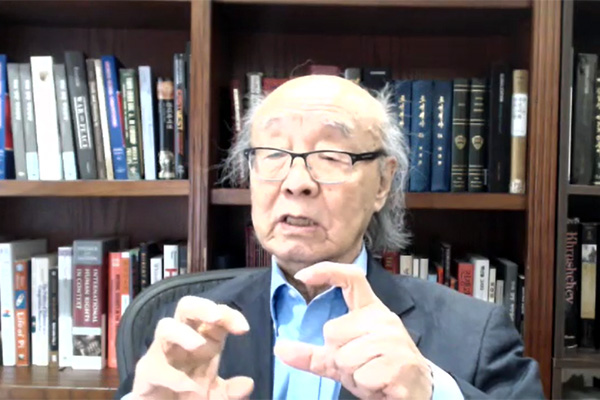
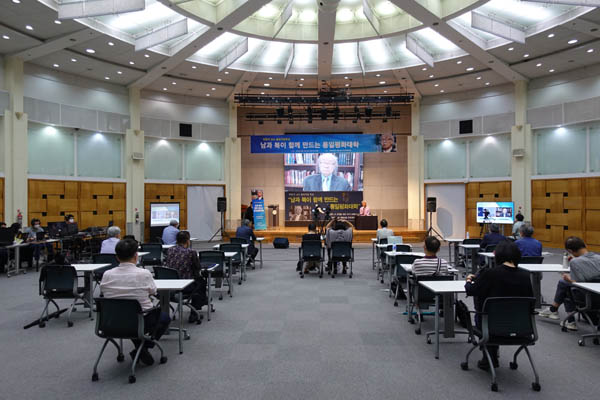
On the 16th, we had a video interview with Park Han-sik, an emeritus professor at the University of Georgia, USA to commemorate the 21st anniversary of the founding of Tongil News. [Captured photo - Tongil News]
---
“What we need now is to implement at least one thing we have done so far, and to sign a peace treaty to move forward. The end-of-war agreement is meaningless and cannot be implemented.”

In an interview commemorating the 21st anniversary of the founding of Tongil News, Park Han-sik (82 years old), an emeritus professor at the University of Georgia in the United States, said that the implementation of agreements between the leaders of the two Koreas, such as the 4.27 Panmunjom Declaration, is more important than the 'declaration of the end of the war' or 'end of the war agreement', which the Moon Jae-in administration is focusing on, and that 'peace' is more important. treaty,” he said.

Professor Emeritus Park Han-sik, who visited North Korea more than 50 times and left a big mark, such as arranging a visit by former President Carter in 1994 and a visit by former President Clinton in 2009 He repeatedly emphasized the need to see North Korea as it is.

Professor Park said, “There have been declarations and agreements similar to the declaration of the end of the war that can be substituted for the declaration of the end of the war. There have been more than five or six agreements between the leaders of the two Koreas,” he asked.

Since the 6.15 Joint Declaration and the 4.27 Panmunjom Declaration and the 9.19 Pyongyang Declaration all contain the content of 'there is no more war', which is a declaration of an end to the war, the declaration of an end to the war is virtually unnecessary if it is followed. Instead, “each country or the United Nations should make efforts for both of the peace treaty and the normalization of diplomatic relations. Moreover, we have to work hard from the south.”

Regarding the North Korean nuclear issue, he said, “I think that there should be a peace treaty, normalization of diplomatic relations, and if Korea is recognized as a normal state in all fields, then it will give up all its nuclear weapons. The possibility is very high.”

In particular, regarding 'reversibility', which allows North Korea to return to a nuclear-weapon state if the United States overturns its promise, even if North Korea has given up its nuclear weapons, "Reversibility is not granted from the outside, and they already have nuclear science, scientists, and raw materials. , I made it, so I turn around and become another nuclear state in just three months,” he explained.

“I believe that complete, verifiable and irreversible denuclearization is impossible. It is realistically impossible, and furthermore, North Korea will never give up its nuclear weapons.” He criticized the CVID (complete, verifiable and irreversible disarmament) imposed by the Western world, including the United States, and gave a negative evaluation to future nuclear tests or intercontinental ballistic missiles. ICBM) launches are expected to be “in proportion to what South Korea and the United States do.”


Professor Park said, "I have lived in the United States for 55 years, teaching and teaching the United States government for 50 years, and I know a lot about the United States." It moves the American economy, moves American public opinion, and moves American policy.”

Therefore, “the United States cannot let the Democratic People’s Republic of Korea go. It continues to be demonized and continues to be the main enemy, and only then will it be beneficial to the military-industrial complex.” In particular, he was wary of the double standard of 'if we do it, we don't see it as provocation, and if the North does it, it is provocation', and pointed out that "the most important problem is ignoring North Korea."

In addition, it is evaluated that China's foreign policy based on Confucianism is more peaceful than the US, which regards the US-China hegemonic competition as a 'competition relationship' that acquires legitimacy from neighboring countries rather than the 'New Cold War' and punishes 'devils' based on the Christian dichotomy. also did

Professor Park said, “Even if the two systems change in any way, we cannot control it, can we? It is good for the two Koreas to exchange exchanges, trade in various ways, and to travel peacefully,” he suggested.

Regarding the revision of the party rules at the 8th Congress of the Workers' Party of Korea in January and promoting 'our national firstism', he said, "We have to look at 'for whom and for what.' He interpreted it as emphasizing the state and said, “Aren’t South and North Korea nation-states? They are not male because they are ethnic. The reason why you can't live like the South is not the South, how can you live like the South?”, emphasizing the justification for national unification.

In order to properly understand the 'Kaesong University of Unification and Peace' advocated by Professor Park recently, one has to unravel the ideas for unification one by one that he has accumulated while serving as a professor at an American university for 45 years. The first part 'Ask for Unification' and the second part 'Ask the University of Unification and Peace' to hear the ideas about the federal system and the University of Unification and Peace were divided into two parts: video interview and additional phone interview.

The following is an interview with Emeritus Professor Park Han-sik through online zoom on the 16th and the following are the questions and answers from the first part of the phone interview, 'Ask for Unification'.

America's Two Primary Colors: "One is militarism and the other is racism"

On August 27th, the publication commemoration of the publication of emeritus professor Park Han-sik's memoir 『Crazy for Peace』 was held at Konkuk University Millennium Memorial Hall. [File photo - Tongil News]
---
□ Tongil News Kimchi Kwan: ​​It's nice to see you in a video like this, even though you're far away. The interview to commemorate the 21st anniversary of the founding of Tongil News begins with Professor Park Han-sik. Thank you for accepting the interview for the founding of Tongil News.

■ Professor Park Han-sik: I'm happy. Thank.

□ I know that you are doing a lot of online YouTube courses recently. Please introduce your recent status.

■ From 1970 to 2015, after I came to the United States to study, I taught at an American university without missing a single year for 45 years. After teaching for 45 years and retiring, I thought of teaching more.

Also, for 45 years, there were some Korean students, but only American and foreign students mainly taught. Now, I wanted an opportunity to share what I learned and felt for my country's juniors and comrades.

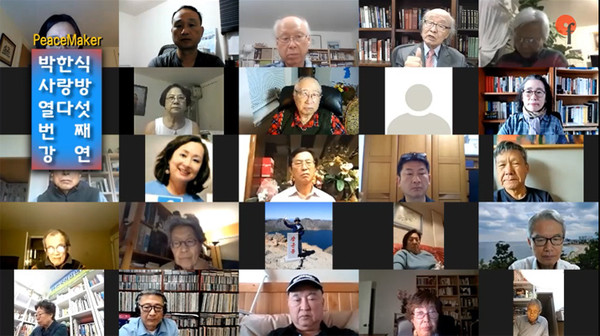
Then, it has been over 15 months since people with a will to gather and hold a Zoom lecture called 'Park Han-sik Sarangbang' once a month. still doing it Also, it's been over a year since I've been appearing on <Souvenir TV> in Korea every week. I am enjoying that opportunity now.

□ Recently, you published the book Crazy for Peace, which had a publication commemoration in Seoul. How was the reaction or reaction?


■ I would like to thank Tongil News for participating as one of the organizations supporting the publication anniversary. This book is a bit progressive. Therefore, it is said that it is read and liked by progressive people and people with a high degree of education.

However, people who are conservative and anti-communist are not going to read this book.

I don't know how widely the book has spread, but it is said that all the people who come to the 'Unification Sarangbang' every month are devouring it. So for me, people who are qualified and ready to read understand that a lot of people are reading. I am delighted.

□ The biggest issue right now is that the US-DPRK relations have come to a complete halt after the US-DPRK summit in Hanoi in February 2019 ended without results. What is the cause and how can the North American dialogue proceed? Or is it impossible to go on forever? I'd love to hear your opinion.

■ The fact that the Hanoi summit was accomplished is only the shape of it. Practically, there was no desire or plan to improve relations with the Democratic People's Republic of Korea on the part of the United States.

It still is. I have lived in the United States for 55 years, teaching and teaching the US government for 50 years, and I know enough to know America. However, the more you look at the United States, the more the United States is moving by its natural color, the two primary colors. One is militarism and the other is racism.

I'm glad I'm teaching college here as a non-white person, but it's a very difficult place for non-whites to live in the United States. And it is the military-industrial complex that strikes the fortress plate in the United States. In the military-industrial complex, it moves the American economy, moves American public opinion, and moves American policy.

With that in mind, the United States cannot let the Democratic People's Republic of Korea go. It will continue to be demonized and continue to be the main enemy, and only then will it be beneficial to the military-industrial complex. Arms should also be sold to South Korea, Japan, and other countries. Therefore, it is most important for the United States that North Korea remain the main enemy. It should continue to be so.

Therefore, it seems that the United States has no intention of improving relations with North Korea. That's why it's been like this since Hanoi. Sanctions and sanctions have been repeated, and these sanctions have no particular reason. Because North Korea is communist, because North Korea doesn't listen, 'I can't leave it alone. We must not continue to exist on this planet.” There is an American intention.

Therefore, as long as there is such a thing, it is difficult to improve US-DPRK relations or maintain peace on the Korean Peninsula. Peace is not only the absence of conflict, but peace is the process of finding homogeneity by harmonizing heterogeneity and heterogeneity. In this way, peace has not been successfully pursued over the past 70 years.

That is why I assert that no progress has been made on the Korean Peninsula or in North Korea-U.S. relations because of this, the US tendency, US thinking, and US policy line.

□ If the prospects for US-DPRK relations are bleak, is there any way to get through the US-DPRK relations in the future?

■ Much of the responsibility rests with the United States. One 70% is the responsibility of the United States. America doesn't want to do it all. Because the current situation is good to contain China and expand the power of the United States internationally.

Its strategy is to demonize North Korea and use North Korea as a bait to militarize South Korea, Japan, and allies. Putting other countries here, Australia and India are all democracies. They are trying to put pressure on China, but South Korea should not be involved in that.

□ Is the US-North Korea relationship difficult to predict in the future?

■ It is difficult to see good prospects. However, improving US-DPRK relations should not be just “denuclearization, denuclearization”, but rather, each country or the United Nations should strive for both a peace treaty and normalization of relations. Moreover, we have to work hard from the south.

North Korea is also making a lot of effort to change various laws within the country to normalize it these days. Since we are the same people who know the North well, we must take the lead in expanding and modernizing the North. Not only economically and materially, but also consciously, North Korea is very contracted right now. I am so obsessed with the victim consciousness.

North Korea's nuclear weapons, CVID is impossible... A normal state must be recognized to give up its nuclear weapons
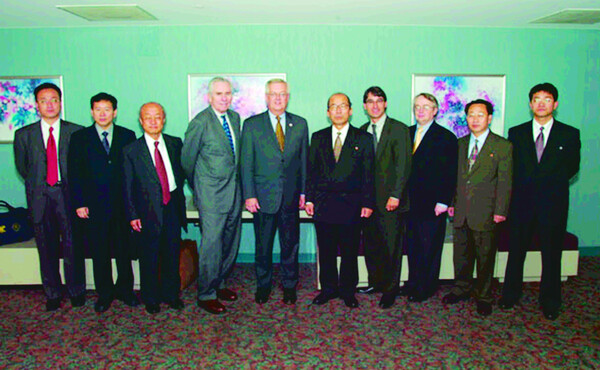
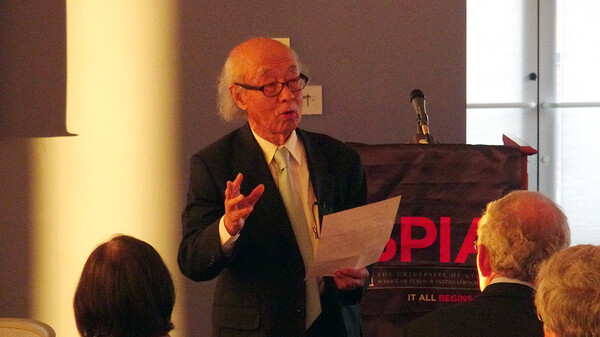
Professor Hansik Park hosted the 'North Korea-US Track 2 Talks' at the University of Georgia in December 2003. From left to right: Disaster of the North Korean mission to the United Nations Shin Sung-cheol, Deputy North Korean Ambassador to the UN Han Seong-ryeol, Professor Park, former US Ambassador to Korea Donald Gregg, US Representative Kurt Weldon, North Korean leader Cho Sung-koo (Disarmament and Peace Research Institute), and U.S. Senate Democratic Advisor Frank Januzi , Keith Ruth, Republican aide to the Senate Republican Party, Kim Myung-gil, director of the Asia-Pacific Peace Committee, and Shim Il-kwan as an interpreter. [Photo courtesy of Professor Park Han-sik]
□ If it is a North Korean issue, the Western world is raising the nuclear issue. I know that in the past, during negotiations with the United States, the thesis of “Let North Korea give up its nuclear weapons but give it ‘reversibility’” was published. How do you see North Korea's nuclear weapons problem and, more broadly, the denuclearization of the Korean Peninsula?

■ I've tried in various ways so far, but the first button to unlock it has not been put on. The reason is very simple. If we are going to solve the nuclear problem, we must first understand why North Korea pursued nuclear weapons.

If becoming a nuclear state is the goal in itself, it will never be resolved. You cannot give up on purpose. However, from my point of view, the fact that North Korea is trying to acquire nuclear weapons is a means of diplomacy and a means of national security. The means can be changed. It can be replaced by other means that serve the same purpose.

The only reason why we wanted, pursued, and tested nuclear weapons was to protect the country and the system. In other words, if the international conditions for safeguarding the country and system and maintaining peace without nuclear weapons are guaranteed, nuclear weapons are to be given up.


why? He said he would give up, and that is because President Kim Il-sung, who served as an idol there, had instructed him to do so. In my view, nuclear weapons are given up when all conditions are met, and those conditions should be the same as the purpose of pursuing nuclear weapons.

The goal is to maintain the system, and in order to achieve this, there must be a peace treaty involving multi-states. We will not give up our nuclear weapons even with a non-aggression pact or a declaration of an end to the war. I think that there must be a peace treaty, normalization of relations, and in all fields, Korea will be recognized as an ordinary country, and if this is the case, it will give up all its nuclear weapons. However, if that doesn't happen, I never give up, and even if I give up, there is a very high chance that I will go back.

“Isn’t it reversible?” A lot of people ask about this, but reversibility is not given by the outside, and they already have nuclear science, scientists, raw materials, and made them, so they turn around and become another nuclear state in just three months. So, reversibility is something you already have, not something that others or the United States give you.

Recognizing that and saying, “Let’s give up because we will cooperate to become ready to give up nuclear weapons.” You have to do this to give up, and you never give up if you just forcefully unilaterally do it.

□ Since North Korea has Corona and the United States is not making a dialogue proposal that meets the conditions, I wonder if it will be time to 'solidify' its status as a nuclear weapons state as time goes by anyway. how do you see

■ It would be wrong to view North Korea as buying time to solidify its nuclear weapons, and it will only lead to further anger in North Korea.

North Korea is already a nuclear state. They made nuclear weapons and tested them six times, developed several types of guided missiles capable of carrying nuclear weapons and successfully tested them. Even now, the computer asks 'Who is the nuclear state?' If you look, most of them include North Korea. In reality, it has already become a nuclear state.

However, buying time to become a nuclear state is an anachronistic and anachronistic diagnosis.

And how do we give up nuclear weapons? In some circumstances, the United States and the International Atomic Energy Agency (IAEA) said, "That's it. That's enough." Would you let me go? never let go For this reason, for that reason.

It also has to be completely proven, but there is no way to do it. Moreover, it is absurd to say that it must be done irreversibly. So I believe that complete, substantiated and irreversible denuclearization is impossible. It is practically impossible, and moreover, North Korea will never give up its nuclear weapons.

□ You already saw that North Korea possesses nuclear weapons. Do you expect North Korea to conduct nuclear tests, intercontinental ballistic missile (ICBM) launches, or artificial satellite launches in the future?

■ What North Korea does is proportionate to what South Korea and the United States do. It's not just that he's doing it himself, he'll do it if he does it in South Korea.

However, the thing that North Korea is most interested in and caring about is that “a double scale should not be applied”. 'If we do it, we don't see it, and if the North does it, it's a provocation' and let's not do that.

The most important problem is ignoring North Korea. It's a slang word. North Koreans know too well that we look down on North Korea. As I go through the drums, I feel with my skin, “Why do we have to be looked down on?” We are not a country that is so bad as to belittle North Korea. North Korea has many things to be proud of.

So, if we look at North Korea positively and do not look down on it, inter-Korean relations will improve quickly, and US-DPRK relations will improve as well. This is because there is no structure of consciousness. This is because of anti-communist education, etc.

End-of-war declaration is meaningless, “peace treaty must be signed”
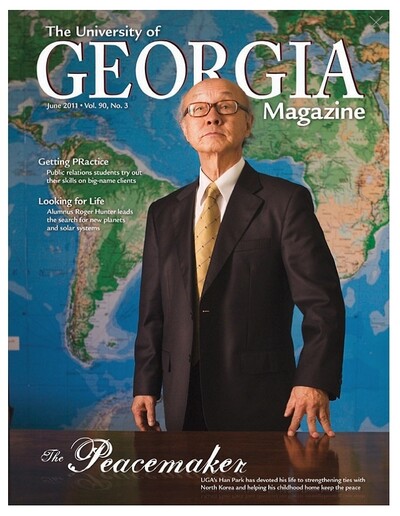
Professor Park Han-sik, who won the 2010 Gandhi King Ikeda Peace Prize, was introduced as a 'peacemaker' on the cover of 2011. [Photo courtesy of Professor Park Han-sik]
□ Inter-Korean relations have also recently become difficult, but it seems that the South Korean government, including President Moon Jae-in, is focusing on the 'declaration of an end to the war'. In other words, it seems that the declaration of an end to the war is being pursued as an entrance to dialogue. So far, the North's reaction has not come out clearly, but it seems to be critical. Do you think the end-of-war declaration can be the key to overcoming the current difficulties?

■ Until now, there were declarations and agreements similar to the declaration of the end of the war that could be substituted for the declaration of the end of the war. There have been more than five or six times between the leaders of North and South Korea. Even if only half of them are implemented, there will be no war if only one of the 6.15 Joint Declaration, 4.27 Panmunjom Declaration, and 9.19 Pyongyang Declaration are implemented.

I don't think it's right, but don't you think that not war is usually peace? In that sense, I think that a peace treaty is necessary, but it is not necessary and meaningless to make an end-of-war agreement or such an organization. Now, after signing the five or six agreements, what's the use of adding one more?

What we need now is to implement at least one of the things we have done so far, and to sign a peace treaty to move forward. The previous agreement is meaningless and cannot be implemented. There is no reason for it to be fulfilled just as everything has not been fulfilled. I don't think positively or optimistically about it.

□ Do you think the North will not respond to the declaration of an end to the war?

■ Yes. The North will think similarly to my story. “If you keep your promises, the war has already ended, so why do you have to sign again? There is a situation where it disappears to pieces of paper, but there is no point in doing it for us.” I think so. You have to show that it isn't, and you have to convince the explanation, but I don't think there's any way I can convince you.

□ Currently, South Korea and the United States are not responding to dialogue and are particularly concerned about 'double standards' and 'hostile policy'.

■ The double standard proves that the drum is demonized. He is not a civilized person, and he does not keep his promises. However, North Korea is not the only one who is not keeping its promises.

The double standard means that military training in the North is a provocation, and if it is in the South, it is justified for security, and it should not be done like this. If that's the case, everything the drums always do is bad. And even if it is necessary, if it is done in the United States or Korea, it is justified and should not be done this way.

It is said that if you do it that way, you will not be able to respond, and if you do, you will not see any results. Standards should be the same between ordinary countries and ordinary countries. If you think there is a double standard, the South and the US should thoroughly understand that North Korea will not respond to the summit.

North and South Korea “Deceive the People”

A farewell lecture on peace studies at the University of Georgia retirement ceremony in December 2015. [Photo source - University of Georgia website]
□ One of the remarks that caused controversy or wavering in the South recently is that former Unification Minister Jeong Se-hyeon should aim for 'inter-Korean union' rather than unification, which is not immediately feasible, and change the Ministry of Unification to the 'Ministry of Inter-Korean Relations'. how do you see

■ To put it bluntly, it doesn't fit common sense and it doesn't fit the historical truth. What was the agreement at the top level of the two Koreas about six times? Did you not agree to unify? Apart from unification, unification is so important that it is difficult to justify the existence of our government in the South and the North.

As for the method of unification, as agreed in the 6.15 Joint Declaration, in the North it is a 'low-level federation system' and in the South it is a 'federation system'. In my view, there is no premise or reality that the coalition system will become one country next time even if you look at all the world literature.

A coalition is an economic, political, and ideological gathering in which completely independent sovereign states come together to achieve a specific goal through cooperation with each other. The United Nations is the Union and the EU is the Union.

Does the EU look like a country? is that for that purpose? Does the United Nations aim to become one world state? It's not like that. This is simply a matter of consolidating and forming alliances with each other for convenience, or by forming alliances in such a way.

To view the coalition system as a process between the South and the North toward unification is to deceive the people. You never get that result.

To achieve unification, it must be some kind of federation. If you do not want to do so because the North says that it is a 'lower-level federation', in other words, it is called a 'creative federation' or a 'creative federation'. There must be a human body, a government or a system. I think what Minister Jeong said is absurd.

□ Recently, the theory of two nations and the theory of friends are popular in the south. For example, there are suggestions about changing the Ministry of Unification to the Ministry of Inter-Korean Relations, how do you view this trend or trend?

■ Then, “Let's give up on unification. We have been divided by foreign powers, but we cannot reunify on our own, so let's accept it as a completely different country." do that Good people should not be deceived like that. It shouldn't be done as if it was unified.

If we go as Minister Jeong said, the immediate goal of coalition is to eliminate the Ministry of Unification and to make it an inter-Korean relations department. If the Ministry of Unification does not feel good, it can be replaced with the Ministry of Unification. Because we've reached an agreement five or six times to become self-sufficient. Either make it an independent Ministry of Unification, or get rid of the Ministry of Unification and not unify it.

If 7,80% of the people want it, they have no choice but to go there. However, from my point of view, more than half of our country, 70%, consider unification to be a legitimate goal. In the North, it is 100%. Going in the direction the people and the people want is the right political ideology, whether it be democracy or socialism.

“The Cold War is over in history”...The US and China are 'competition'
Emeritus Professor Park Han-sik is taking the lead in unification education through Zoom lectures in 'Park Heon-sik Sarangbang'. [Captured photo - Tongil News]
□ The biggest structural change in the recent unification conditions seems to be the intensification of the US-China hegemony competition. As the competition for hegemony between the US and China intensifies, there are concerns that the new Cold War on the Korean Peninsula will also intensify. In such a situation, what do you think is the direction and method of unification between the two Koreas?

■ I have a different opinion on that. It is said that an international new Cold War order is coming, but the Cold War has ended in history. The confrontation of ideologies, the military competition, and the absence of hot wars, but of the Cold War, put an end to decades of history.

The current US-China relationship is a competitive one. Even if it is a competition, it is a systemic competition that eats more land and turns international public opinion on them rather than such a competition. It is such a competition to make international public opinion more favorable to me.

It will not develop in the direction of the Cold War era in which China and the United States accumulate military weapons through armed competition. They each go to different countries and try to dominate the world opinion that their system is more justified and more convincing.

Therefore, China is not taking the lead in military power these days, but promoting social and cultural 'Chinese-style socialism'. The 'Chinese-style socialism' that President Xi Jinping refers to means Confucian-style socialism. Therefore, the Chinese government has provided a lot of support to revitalize Confucianism at home and to study Confucianism internationally.

What China wants is not to go between the two systems as in the past, but to allow the various systems to live in different ways. This is the blueprint for China's change of world order.

There is always a polarization in the dominance of Christianity as in the United States. I told you to love the chosen people and the unchosen people, the right and the bad, the enemy. It's not Christianity. The devil must be killed. So, Christianity is supposed to put the devil at the forefront and kill the devil, whether it's a gangster or something.

However, since China operates on the Confucian principle of living together, I think there is little chance of a military confrontation between the two countries due to military friction.

No matter how the two systems change, we can't control it, can we? So what should we do? The two Koreas should do what the two Koreas can do. It is better to allow the two Koreas to exchange exchanges, trade in various ways, travel, and do this peacefully.

However, “it was divided. Someday we will have to unite. I think politics should be conducted with a blueprint that unification should be done in this way.” There is no unification blueprint in Korea right now.

Why can't we unify now? The federal system in the North can do it right now. When you create a federal state, it becomes a federal system. Wouldn't it be a low-level federation if you gave the state a minimal amount of power? Then it becomes a federal state from the next day.

Why not right now? I can't because I'm trying to unite. We need to know in common sense that unity is never one way to unify, and I don't think it's right to say it differently.

□ It is fresh to say that the current world order is a competitive relationship between the US and China rather than the new Cold War. But from a historical perspective, isn't China's nationalism a threat to us as much as the United States? Is it correct that the United States seeks demonization through the Christian dichotomy and China seeks coexistence through Confucian principles?

■ Confucianism cannot be regarded as hegemonism. Christianity is hegemonism. Hasn't there always been a religious war around the world by setting up a Christian flagpole historically? Confucianism is not a religion that encourages military confrontation in that sense.


We know Confucianism, we know Christianity, and we know everything. So is the North. If you look at religion, Buddhism, Christianity, and Confucianism are all mixed together, and one person has all three religions. When I was a child, I prayed on my face during the ancestral rites.

To that extent, our people are religious, but they do not have an exclusive religion. That is why I believe that we can use the religious role well to create a more harmonious unified state and system.

8th Party Congress, “Planned downgrading of the nation”
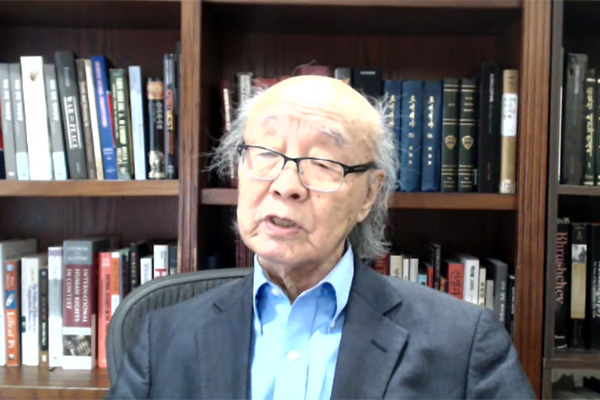
During the long interview, Professor Park Han-sik immediately answered all the questions with an upright posture. [Captured photo - Tongil News]

□ I did not include it in the questionnaire, but I am asking because I think many people will be curious. North Korea is now estimating that it will be quite difficult internally due to international sanctions, lockdown measures due to the prevention of COVID-19, food shortages due to natural disasters just last year, and various problems.

In the north, while advocating for a frontal breakthrough, they are promoting self-reliance and self-reliance. I am very curious about what will happen. The professor has visited the book several times and I know that he understands the internal flow much more deeply than we do. How do you see North Korea's current reality and the battle for breakthrough head-on?

■ First of all, North Korea will never collapse. We need to know that objectively. There are many ways to maintain one's own system and maintain legitimacy.

See the 8th Party Congress. Look at the various policy expressions that have emerged. As long as the system becomes more solid, it will never collapse. There is no case in the world where the political system has collapsed due to economic difficulties or hunger among the people in any country in the world.

The system must lose its legitimacy before it collapses. With legitimacy, it cannot collapse. North Korea's legitimacy has never been found in economic prosperity. find in ideology. The ideologies that justify North Korea are nationalism, populism, and Juche ideology. As long as these ideologies are effectively working to unite the people, they will never collapse.

South Korea is waiting for North Korea to collapse. When it collapses, it is unified, and that is German unification. It is absorption unity. These are all children's cartoons, far from realistic politics.

The South Korean government, intellectuals, and the media should somehow capture the North Korean situation as it is and create such a unification policy and inter-Korean relations that can be applied realistically, but now things are going differently.

□ North Korea amended its party rules through the 8th party congress and advocated 'our nation firstism' rather than 'our nation firstism'. In the case of the <Hankyoreh>, which first reported the revised party rules, and former Unification Minister Lee Jong-seok, "Isn't North Korea giving up on unification? Isn't it a return to nationalism rather than nationalism?" These interpretations are presented. What do you think?

■ That's a very bad idea. North Korea has never undermined or given up nationalism in the slightest. It is still the same now.

Wasn't that kind of atmosphere at the 8th Party Congress? What you should always see is 'for whom, what is the event for?' You have to look at it. The 8th Party Congress was not aimed at the South. It was aimed at the world. Kim Jong-un, the general secretary, declared that he would lead such a country.

Therefore, the state was emphasized as important. If the nation is important, international cooperation is not good. The United States is even more so. To the United States, you may not know what we mean when we say that we are pursuing our nation. America is by no means a nation-state. I don't know what the nation means. I don't know if there are 20% Anglo-Saxons, but it's not a nation-state.

But aren't South and North Korea nation-states? They are not male because they are ethnic. The reason why you can't live like a man is because it is not a man, how can you live like a man?

I've been to Pyongyang about 50 times, and every time I go, I feel like, 'Oh, this is our people'. I just listen to 100% of what they say, and if we ask to eat something together, we eat together with kimchi and with soybean paste.

And there is something to humble yourself. In America, there is no way to live if you are humble. North and South, “What do I know?” It should be like this, but in the United States, if I don't say that I am the best, I will never win the election. In Korea, they are learning it.

Our nation's strengths, modesty, and the tendency to oppose other people's positions are very good characteristics of our nation. We must not give up all these things and go out selfishly.

Therefore, the unification we are pursuing now has to be done with our nation at the forefront. However, the nation should not be set as the object of the world. That is why, at the 8th Party Congress, they deliberately downgraded the concept of a nation.

If you think that we should read it that way, everything has been changed there, it is a mistake. Experts must be able to read what the ear cannot hear and what the eye cannot see. If you read only what is said, you cannot understand the system by licking the watermelon. However, if you look at Kim Jong-un's speeches and other things like that, the nation is still alive. Without nationalism, North Korea cannot exist.

□ The same can be said about unification.

■ 'Give up on unification.' If he had even thought of such a thing, Chairman Kim Jong-il would never have signed the June 15 Joint Declaration. In 6.15, he thought that the method of unification was federation and federation, and admitted that there were slight differences.

Of course, the difference is completely different, but we have to remake the blueprint for unification to suit us. When discussing and discussing unification issues, you should always include the drum. It is better not to discuss or even think about unification and peace without including North Korea.

□ Tongil News celebrated its 21st anniversary. How should we view the role of the unification media in inter-Korean relations?

■ The media is changing all over the world as well as in the US. However, the media has two roles. It could be 50% 50%, it could be 90% 10%.

what are the two reporting the facts. It is very important to report the facts without distortion. Second, to create desirable public opinion. Absolutely need it

There is a lot of talk in the West that the media only reports the facts, but there is no media that only reports the facts. If you look here too, <CNN> and <MSNBC> are very progressive. But <FOX News> is very conservative. So all the media can see the way they are going. Even if you don't show it you can see

In my view, Tongil News is very forward-looking, progressive, national, and unification-oriented because it is unification news. That's important. That is one important part of the role of the media.

And reporting the truth. You must not lie. 'Donald Trump is now president of the United States. But it was stolen and the Democrats took it.' That's 100%, 1000% a lie. But the person who believes that lie will be about 20% of the American population. As a result, the American media is not doing its job, and public opinion has changed to prevent it. The media crisis does not lie with the media, but on the readers and the people who use the media. The media crisis has arrived.

However, we consider it important to report the truth in order to understand North Korea and to correct the unification issue. I think 50%, 50%. We must take the lead in creating a desirable culture of unification and a desirable culture of peace. Even educational institutions are not doing it.

The media has a role to play in the developing world and in our country. So, always keep these two roles in mind, and I hope to develop that way in the future.